The RAT was the first time I'd raced in the dark. And I've done
very little running in the dark full stop. This made me a bit nervous
going into the race but there wasn't a huge amount I could do about it
given that the race was in August - training in the dark would have
meant missing out on sleep and I decided that sleep (and so not risking
getting sick) was more important.
As a member of the Trail Running Team I was lucky enough
to be given a LED Lenser head torch. And I'd had the chance to
practise using it when we were out in the Alps in June. I was
really pleased about this as it meant I knew what I could expect from
the torch and that definitely gave me confidence. In the Alps, I had
felt comfortable running up and down technical Alpine trails. And so I
was fairly certain I'd be ok on the Cornish coastal footpath.
I was more nervous about navigating in the dark. Whilst the race was on a
well-marked long distance trail, my experience (e.g. Our trip to the Isle of Wight) has taught me that this doesn't always mean you
can get away without knowing the route. We bought a map and
spent the days before the race recce-ing the tricky bits - mainly when
the route passed through villages. This wasn't the best option but it
had to do as we couldn't head all the way to Cornwall twice and we
couldn't run the whole 50k (it was a there-and-back route so that would be sufficient for recognising the whole 100k route) in the days running up to the race when we
needed to be resting.
So when I stood on the start line at midnight I felt pretty comfortable with what lay ahead.
The LED Lenser head torch was really impressive. It lit up the path
brilliantly and I felt I could run in pretty much the same way as during
daylight. In reality, I probably wasn't quite as fast but that's not
exactly a bad thing at the beginning of a 100k race! About 30 mins in I
realised that the torch was a bit tight and was pressing on my head. But
I was able to adjust the strap while it was on my head and I kept on
moving while I did this. It was easy to change the direction of the beam (helpful on steep
downhills or uphills) and its brightness.
My one problem was my batteries running out. But this was my fault - I
hadn't put in new batteries for the race and dawn was about 2 hours
later than I'd expected. So the torch lasted 6 hours on not-new
batteries - I don't reckon that's a bad statistic. And it had a helpful
red warning light that flashed when the battery was low. Given it was
almost light I didn't change my batteries. Once the batteries were low, the torch would switch itself
off to preserve the battery that was left. I could see enough to run
most of the time and I was then able to switch it back on for the bits
where I needed a bit of extra light.
And what about getting lost? There were a few parts where I went
marginally off course or went round the perimeter of a field when I
could have taken a direct route across the middle to the next stile /
gate. In fact the only point where I got lost to the point that it
bothered me was after dawn!
In terms of running in the dark, I now feel much less scared about this
aspect of longer races. In an ideal world I'd still want to recce the
night time bit of the course in advance. But a section of night time
running is definitely not something to put me off a race anymore.
Showing posts with label Trail running team. Show all posts
Showing posts with label Trail running team. Show all posts
Wednesday, 28 August 2013

Monday, 22 July 2013
Nutrition - single- versus multi-day events (Hannah)
I'm really interested in nutrition and so, off the back of my recent
article on multi-day versus single-day events, I thought I'd compare how
I fuel myself for each of these...
Until last year my running events had mostly been on road and had maxed out at marathon distance. After my two first half marathons taught me it wasn't sensible to race on water alone, I became a committed user of energy gels. I'd use them in my long training runs and that plus water got me through a lot of races. I never particularly liked the idea of putting such concentrated sweet stuff into my body but it did the trick. I also discovered TORQ gels fairly early on - at least I knew they were pretty natural so I didn't feel I was putting something from the chemistry lab inside me!
When I started training for the Transalpine last year I did a quick calculation and realised I'd need about 60 gels over the course of the week. That just didn't seem like a particularly good idea. I also figured I would lose the taste for them pretty quickly - even towards the end of the Ironman day I find that all I can stomach is coke and that I don't fancy anything sweet for several days.
So I thought back to how I'd fuelled myself for multi-day treks and cycle rides. These had all been done on "proper food" and so I started applying this concept to my running. The intensity I'm at when I'm doing ultras is so much lower than straight road races that digestion hasn't been a problem and I've transitioned pretty well. Most of my Transalpine running was fueled by plain cake or Kelloggs Elevenses bars. During the Transalpine itself I also enjoyed orange segments, cucumber and watermelon at the feed stations. But recently I'm a convert to TORQ bars - I love the fact that the flavours aren't too sweet and that they taste natural cos of the dried fruit inside them. And thanks to the clever science of the guys at TORQ, they're obviously made in a way that gives me exactly what I need from a performance point of view.
The other thing I've learned with multi-day events is the importance of "fueling for tomorrow". When I'm out running, I need to make sure that I don't deplete my energy reserves to a point that will be hard to recover from in time for tomorrow's run. I might sometimes take on more nutrition than is totally necessary to make sure I am always comfortably fueled. I'll also still have a couple of "emergency gels" in my pack just in case - though on the 8 days of the Transalpine I didn't touch these once.
Linked into this is what I eat after I finish each day. Through practice and experimentation I've learned that the difference between eating within 30 mins off finishing versus not is massive when it comes to running the next day. And when I don't then the next day isn't pretty! When I'm doing training runs I'll leave some TORQ recovery powder in the car and some water. I can mix it up and have it inside me within 10 mins off finishing. It goes down really easily, contains everything I need and it's really convenient as it doesn't need to be kept cool. It's less practical if I'm light-packing though (e.g. when we were in the Isle of Wight) as I want to keep my weight down as much as possible. In that case I'll find somewhere that can sell me a chocolate milkshake. I'll usually have a sandwich as well. And on the Transalpine they had a massive vat of quinoa at the finish every day - perfect!
Until last year my running events had mostly been on road and had maxed out at marathon distance. After my two first half marathons taught me it wasn't sensible to race on water alone, I became a committed user of energy gels. I'd use them in my long training runs and that plus water got me through a lot of races. I never particularly liked the idea of putting such concentrated sweet stuff into my body but it did the trick. I also discovered TORQ gels fairly early on - at least I knew they were pretty natural so I didn't feel I was putting something from the chemistry lab inside me!
When I started training for the Transalpine last year I did a quick calculation and realised I'd need about 60 gels over the course of the week. That just didn't seem like a particularly good idea. I also figured I would lose the taste for them pretty quickly - even towards the end of the Ironman day I find that all I can stomach is coke and that I don't fancy anything sweet for several days.
So I thought back to how I'd fuelled myself for multi-day treks and cycle rides. These had all been done on "proper food" and so I started applying this concept to my running. The intensity I'm at when I'm doing ultras is so much lower than straight road races that digestion hasn't been a problem and I've transitioned pretty well. Most of my Transalpine running was fueled by plain cake or Kelloggs Elevenses bars. During the Transalpine itself I also enjoyed orange segments, cucumber and watermelon at the feed stations. But recently I'm a convert to TORQ bars - I love the fact that the flavours aren't too sweet and that they taste natural cos of the dried fruit inside them. And thanks to the clever science of the guys at TORQ, they're obviously made in a way that gives me exactly what I need from a performance point of view.
The other thing I've learned with multi-day events is the importance of "fueling for tomorrow". When I'm out running, I need to make sure that I don't deplete my energy reserves to a point that will be hard to recover from in time for tomorrow's run. I might sometimes take on more nutrition than is totally necessary to make sure I am always comfortably fueled. I'll also still have a couple of "emergency gels" in my pack just in case - though on the 8 days of the Transalpine I didn't touch these once.
Linked into this is what I eat after I finish each day. Through practice and experimentation I've learned that the difference between eating within 30 mins off finishing versus not is massive when it comes to running the next day. And when I don't then the next day isn't pretty! When I'm doing training runs I'll leave some TORQ recovery powder in the car and some water. I can mix it up and have it inside me within 10 mins off finishing. It goes down really easily, contains everything I need and it's really convenient as it doesn't need to be kept cool. It's less practical if I'm light-packing though (e.g. when we were in the Isle of Wight) as I want to keep my weight down as much as possible. In that case I'll find somewhere that can sell me a chocolate milkshake. I'll usually have a sandwich as well. And on the Transalpine they had a massive vat of quinoa at the finish every day - perfect!
Saturday, 20 July 2013
Single day versus multi-day (Hannah)
Last year was all about training for the Transalpine. So our focus was
on getting to a place where we could get up day after day and run the
marathon distance. This year I'm training for a 100k race (the RAT) and
so my training focus during this peak period is a bit different. At the
moment it's all about massive days on Saturday - the sort of days that
almost make ironman training sessions look short!
And this, combined with my recent trips to Chamonix with the Trail Running Team and the Isle of Wight with Brett and my bros, has caused me to compare single and multi-day racing / training and think about what I prefer.
What I've realised is that I prefer multi-day. And that it doesn't have to be about doing a race. I enjoy the journey, the adventure and the camaraderie. I enjoy the fact that the adventure is spread over several days and that at the end of each we can reflect on the day that's gone as well as plan for and look forward to the next. Recently, I've found my Saturday runs getting longer and longer to the point where they're not much fun anymore, especially given all the hot weather we've had recently (not that I'm complaining!).
At the extreme end of the multi-day concept is Jez Bragg's journey that took him the length of New Zealand. What he did earlier this year really inspires me. The places he saw, the people he met, the wealth of experiences he built up. But there are more accessible adventures closer to home and I've found myself building a list of these - the GR20, Offa's Dyke, the Southwest Coastal Footpath, Hadrian's Wall, the Welsh Castles relay route,..... Suffice to say that there's enough I want to do to keep me going for some time. And I want to spread it over a few days and savour the experience rather than rushing to do it in one go and pushing myself into a very dark hole.
So I guess this is all a useful learning and will help me know how to plan future seasons to make sure I'm enjoying myself as much as possible. One thing's for sure - it certainly doesn't mean I'll be slacking off, especially given the list I've now committed to "paper" above! Here's to it...
And this, combined with my recent trips to Chamonix with the Trail Running Team and the Isle of Wight with Brett and my bros, has caused me to compare single and multi-day racing / training and think about what I prefer.
What I've realised is that I prefer multi-day. And that it doesn't have to be about doing a race. I enjoy the journey, the adventure and the camaraderie. I enjoy the fact that the adventure is spread over several days and that at the end of each we can reflect on the day that's gone as well as plan for and look forward to the next. Recently, I've found my Saturday runs getting longer and longer to the point where they're not much fun anymore, especially given all the hot weather we've had recently (not that I'm complaining!).
At the extreme end of the multi-day concept is Jez Bragg's journey that took him the length of New Zealand. What he did earlier this year really inspires me. The places he saw, the people he met, the wealth of experiences he built up. But there are more accessible adventures closer to home and I've found myself building a list of these - the GR20, Offa's Dyke, the Southwest Coastal Footpath, Hadrian's Wall, the Welsh Castles relay route,..... Suffice to say that there's enough I want to do to keep me going for some time. And I want to spread it over a few days and savour the experience rather than rushing to do it in one go and pushing myself into a very dark hole.
So I guess this is all a useful learning and will help me know how to plan future seasons to make sure I'm enjoying myself as much as possible. One thing's for sure - it certainly doesn't mean I'll be slacking off, especially given the list I've now committed to "paper" above! Here's to it...
Tuesday, 25 June 2013
Trip to the Alps with the Trail Running Team (Hannah)
I've just got back from a really inspiring weekend in the alps with the
Trail Running Team. It was just brilliant being back in the
mountains spending long hours out on the trails. And I loved being able
to spend time being to know the other team members. A huge thank you to
Julie and Simon from Freestak for making this possible.
We arrived on the Thursday and the weather was a bit dodgy in Chamonix. So that meant we had a very chilled afternoon sitting around and getting to know each other before Julia from Tracks & Trails came to brief us on the next few days. Julia lives and works in Chamonix and was our guide. It definitely made a difference (and felt like a real treat) having someone to show us good routes rather than losing time fiddling around with maps. Julia was also full of all sorts of facts about the area (flora, fauna, history etc) and that added something to the whole experience.
Day 1 (Friday) was a loop out from Chamonix - we pretty much followed
the Mont Blanc marathon course. It definitely threw us right in at the
deep end especially given we hadn't acclimatised at this stage. But the
fact that everyone finished with a smile on their face showed that Julie
and Simon had picked a team of tough and determined individuals! The
uphills were the perfect opportunity to get to know each other. Alpine
climbs are totally different to the short sharp hills of Surrey and you
can often time your ascent in hours rather than minutes. So we power
walked them at a determined pace but one which was slow enough to enable
us to talk - i.e. we were still aerobic. We talked about all sorts of
things and I have definitely left the weekend with some new friends who
will inspire me to do some exciting things.
At the end of day 1 we returned to Chamonix where we enjoyed the local cuisine (i.e. variations of cheese, bread, ham and more cheese). And we also had the chance to tweak our kit and nutrition before the two day adventure that was to make up the rest of the weekend. Day 2 (Saturday) was long and tough but saw us finish up high at a mountain refuge. Day 3 (Sunday) was the return to Chamonix.
Day 2 involved a huge amount of climbing - over 3000m of ascent and that
made it bigger than any day of the Transalpine in that respect. But we
were incredibly lucky with the weather and throughout the day we were
treated with the most breath-taking views. At the beginning of the day
Mont Blanc towered above us looking so amazing it almost looked
superimposed. As the day progressed we could turn around and look back
at our whole route and give ourselves a pat on the back!
Our big climb for the day was the Col de Tricot. The last little bit was
on snow and ice and the top felt quite exposed. The descent was the
type I struggled with on the Transalpine - steep and long with lots of
loose rocks. But I was really pleased with how it went - partly as a
result of the previous day's lesson but also cos of the leg weights and
plyometrics I've been doing since January. My legs felt strong and that
also helped on the uphills.
After the descent off the col we were rewarded with a really delicious
blueberry tart. One of the joys of running in the Alps is the alpine
cafes you come across - a chance to rest for a while and refuel. That
said I found that regular stops made it trickier to get my fuelling
strategy right and also meant my muscles seized a bit. I've been
carrying a slight muscle spasm in my right calf since the Isle of Wight
and this was really sore after some of the breaks. However wearing a
Compressport calf guard (hyperlink) on that leg did seem to help. I
would also try and do friction work whenever we stopped to keep the
muscle warm and mobile.
One of my favourite parts of the weekend was our stay at the mountain
refuge. I love staying somewhere which is only accessible to those
who've made a physical effort to get there. The refuge was a 2 hour hike
up a very steep rocky path. The views were 360º and were amazing. The
whole experience felt really special.
As we were going to sleep (all bunked up mountain-style - side-by-side
in a massive dorm with serious mountain climbers and about 30 children)
there was a rush of excitement as the children all ran out of the room
shaking the floorboards as they went. There was a red glow so we all
wrapped ourselves in our duvets and huddled by the window to see what
was going on. A beacon had been lit outside the refuge and dots on the
distant mountains suggested the same had been done all around the
valley. It was St John's day and this is how they celebrate.
It was a short night as we crept out of bed at 4am so we could do some
night running and test out our LED Lenser head torches. It's
the first time I've run in the mountains in the dark and I really
enjoyed it. I was also super-impressed at the head torch which lit up
the path so well that I was confident ascending and descending on the
thin rocky mountain paths.
After our early morning high altitude hill rep session we were all ready for breakfast before heading off down the mountain at 6am. I love being up at that time before the rest of the world has woken up. On this occasion we were lucky enough to see a group of make ibex grazing on the mountain - a rare treat.
Day 3 was still long but easier in terms of ascent and descent which was
welcome as we were all getting tired. That said, Julia was good at
making sure we ran when we could. When you're walking the long steep
climbs it's easy to get lazy and keep walking when the terrain flattens
out. Julia wouldn't let us do that and I appreciated that.
As I've already said, it was brilliant being back in the mountains and I'm now feeling motivated to go back for more. I'm also now feeling confident that I am well again after my chest infection and my running is getting back on track. So it's time to start planning my race schedule for the rest of the year and committing to some events...
We arrived on the Thursday and the weather was a bit dodgy in Chamonix. So that meant we had a very chilled afternoon sitting around and getting to know each other before Julia from Tracks & Trails came to brief us on the next few days. Julia lives and works in Chamonix and was our guide. It definitely made a difference (and felt like a real treat) having someone to show us good routes rather than losing time fiddling around with maps. Julia was also full of all sorts of facts about the area (flora, fauna, history etc) and that added something to the whole experience.
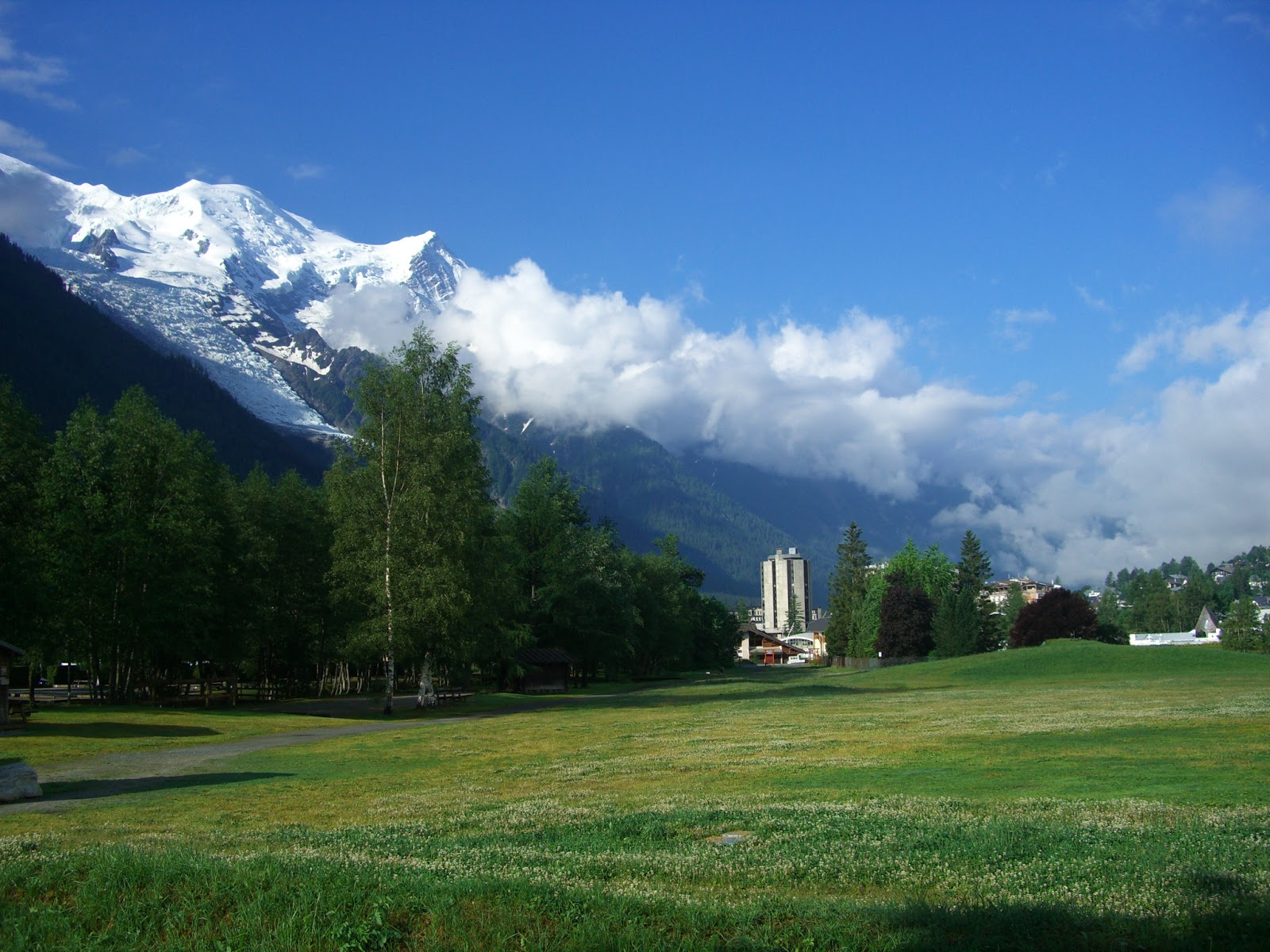 |
| The start on day 1 - pretty special! |
 |
| Getting ready for the descent... |
The downhills were less about talking and more about focusing.
Apparently you slow by about 20% if you natter! On the first day Julia
gave us a lesson in descending which I found really helpful - I wish I'd
been lucky enough to have had that experience before last year's
Transalpine. The tips that really worked for me were:
- Keeping a wide stance and using the edge of the path (a bit like a bobsled)
- Dropping your shoulder and head into the corner to bring you round (like on a bike)
- Staying light on your feet and accepting that your footing might not be perfect and you'll move on quickly
- Constantly flicking between looking ahead and looking in front (long vs short sight) - and making sure you really do look ahead and think about what's coming up
At the end of day 1 we returned to Chamonix where we enjoyed the local cuisine (i.e. variations of cheese, bread, ham and more cheese). And we also had the chance to tweak our kit and nutrition before the two day adventure that was to make up the rest of the weekend. Day 2 (Saturday) was long and tough but saw us finish up high at a mountain refuge. Day 3 (Sunday) was the return to Chamonix.
 |
| Stunning view back to Chamonix after our first climb on day 2 |
 |
| Climbing... |
 |
| Top of the first climb - spot the mountains peeking through the clouds... |
 |
| Almost at the top of the Col de Tricot |
 |
| Looking back at the descent off the Col de Tricot - you can see the path zig-zagging down |
 |
| Blueberry tart - yum! |
 |
| Mel & me at the refuge - behind us we could see our route all the way from Chamonix |
 |
| Sweaty smelly clothes hanging up to dry |
 |
| The view in the other direction |
 |
| Flares for St John's day |
After our early morning high altitude hill rep session we were all ready for breakfast before heading off down the mountain at 6am. I love being up at that time before the rest of the world has woken up. On this occasion we were lucky enough to see a group of make ibex grazing on the mountain - a rare treat.
 |
| Ibex |
As I've already said, it was brilliant being back in the mountains and I'm now feeling motivated to go back for more. I'm also now feeling confident that I am well again after my chest infection and my running is getting back on track. So it's time to start planning my race schedule for the rest of the year and committing to some events...
Subscribe to:
Posts (Atom)